

Table of Contents
- What You'll Need Before Starting
- How to Check Tyre Pressure Before Inflation
- Step-by-Step: How to Use Portable Tyre Inflators
- How to Use a 12V Tyre Inflator in Your Vehicle
- Recommended Tyre Pressure for Passenger Vehicles
- Safety Precautions and Best Practices
- Common Mistakes to Avoid When Using Portable Tyre Inflators
- Troubleshooting Common Issues
Last Updated: July 13, 2026
What You'll Need Before Starting
Before inflating, gather a portable tyre inflator, pressure gauge, your vehicle's recommended PSI (from the door placard), and safety glasses. Ensure your inflator is fully charged if USB-powered, or has access to a 12V outlet if DC-powered.
Essential Equipment and Safety Gear
Safety glasses protect your eyes from valve stem debris. Work gloves provide grip and hand protection. A flashlight helps during low-light inflation. Your inflator should have a digital display, pressure sensor, and quick-release chuck that fits your valve stems securely. Keep a separate pressure gauge as a backup verification tool.
Power Source Options: USB-C vs 12V DC
USB-C inflators charge from any power bank or wall adapter, offering portability ideal for emergency roadside kits. 12V DC inflators connect directly to your vehicle's cigarette lighter, delivering consistent power without pre-charging. Research shows 12V models inflate 20-30% faster due to higher power delivery. Choose USB-C for portability and travel; choose 12V for daily commuters needing semi-permanent installation.
How to Check Tyre Pressure Before Inflation
Your vehicle's recommended PSI appears on the door placard (driver's side door jamb), fuel door, or owner's manual. Most passenger vehicles recommend 30-35 PSI, though this varies by vehicle weight and size. Check pressure when tyres are cold, at least three hours after driving, for accurate readings.
Reading Your Vehicle's Door Placard
Open your driver's side door and locate the label on the jamb. It displays recommended pressures for front and rear tyres, often with separate specifications for different load conditions. A compact sedan might specify 32 PSI while an SUV requires 36 PSI. Under-inflation by just 5 PSI reduces fuel economy by 3% and increases tyre temperature dangerously.
Using a Tire Pressure Gauge Accurately
Digital gauges provide accurate readings within 1-2 PSI. Press the gauge firmly onto the valve stem until you hear a slight hiss, indicating a seal. Analog gauges work similarly but require careful needle reading. Check all four tyres, including the spare, and record readings before inflation.
Step-by-Step: How to Use Portable Tyre Inflators
The inflation process takes 10-15 minutes total per vehicle and becomes intuitive after your first attempt.
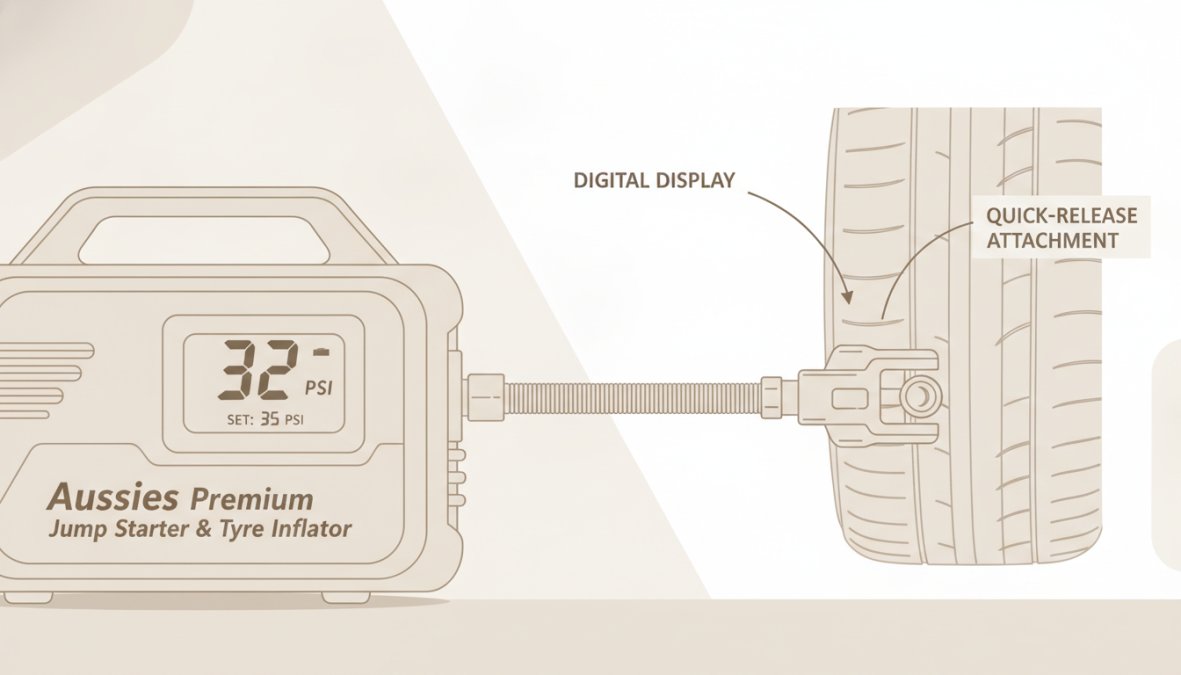
Step 1: Prepare Your Inflator and Check Power
Check the battery level on USB-powered models. Inspect the device for visible damage or leaks. Position your vehicle on level ground away from traffic, engage the parking brake, and turn off the engine. Allow tyres to cool for at least three hours before checking.
Step 2: Connect the Nozzle to the Valve Stem
Remove the valve stem cap and set it aside. Select the correct nozzle attachment, most cars use standard Schrader valves with the larger nozzle; motorcycles and bicycles use Presta valves with smaller adapters. Press the nozzle firmly onto the valve stem at a 90-degree angle. You should hear a slight hiss as the connection seals.
Step 3: Set Your Target PSI
Use the digital display buttons to set your target pressure to match your vehicle's door placard. If your placard shows 32 PSI, set the inflator to 32. Confirm your target before beginning inflation to avoid over-inflating.
Step 4: Begin Inflation and Monitor Progress
Press the start button. Most portable inflators have auto-shutoff that stops when reaching target PSI. Watch the digital display as pressure climbs, most tyres reach target in 3-5 minutes. Some inflators include a work light for nighttime inflation.
Step 5: Disconnect and Verify Final Pressure
Press the quick-release button to disconnect the nozzle. A small amount of air escapes during disconnection, this is normal. Immediately replace the valve stem cap. Use your separate pressure gauge to verify final PSI. If pressure is 1-2 PSI below target, reconnect and add air. If 2+ PSI above target, you've over-inflated slightly. Repeat for all four tyres.
How to Use a 12V Tyre Inflator in Your Vehicle
Powering from Your Car's 12V Outlet
Plug the inflator's power cable firmly into your vehicle's 12V outlet (usually in the dashboard or center console). The display lights up, confirming power. Route the cable carefully to avoid interference with pedals or steering. Start your vehicle's engine before inflating, the outlet provides power only when the engine runs.
Understanding Auto-Shutoff Features
Auto-shutoff stops inflation when reaching target PSI, preventing over-inflation and protecting your battery. The internal pressure sensor detects target pressure and switches off the compressor motor. However, final pressure may vary 1-2 PSI from your target due to sensor calibration tolerances. Always verify with a manual gauge before considering inflation complete.
Recommended Tyre Pressure for Passenger Vehicles
The door placard specifies pressures tested and approved by your vehicle's manufacturer. Most passenger cars operate optimally at 30-35 PSI. Compact sedans typically use 30-32 PSI; larger sedans and crossovers require 33-36 PSI; heavy SUVs and trucks may specify 35-40 PSI. Never inflate to the maximum sidewall pressure rating, this represents the highest safe pressure the tyre can withstand, not the optimal operating pressure.
Cold vs. Hot Tyre Pressure Readings
Cold tyre pressure is the standard measurement for all recommendations. Cold pressure means the vehicle hasn't been driven for at least three hours. Morning checks before driving provide accurate readings. Driving generates friction that heats tyres, increasing pressure by 3-5 PSI. Never adjust hot tyres downward; wait for them to cool before rechecking.
Seasonal Adjustments and Safety Margins
Cold winter weather reduces pressure by approximately 1 PSI for every 10°C temperature drop. Check pressure monthly during winter and increase by 1-2 PSI above the door placard recommendation to compensate. Summer heat increases pressure by the same ratio; reduce pressure by 1-2 PSI during peak summer if your vehicle sits in direct sunlight.
Safety Precautions and Best Practices
Avoiding Over-Inflation and Under-Inflation
Over-inflation reduces tyre contact with the road, concentrating pressure on the centre tread and causing accelerated centre wear, reduced traction, and harsh ride quality. Under-inflation increases sidewall flexing and heat generation, causing accelerated edge wear and increased fuel consumption. Both conditions reduce tyre lifespan by 20-30%. Use your vehicle's door placard as the absolute reference, visual inspection cannot determine if a tyre is at 28 or 32 PSI.
Heat Dissipation and Duty Cycle Management
Portable inflators generate heat during operation. Most are designed for intermittent use, inflate one or two tyres, then rest. Continuous operation for 20+ minutes risks overheating and automatic shutoff. Pause 2-3 minutes between tyres. The housing should be warm but not too hot to hold. Battery-powered inflators also benefit from duty cycle management, which extends battery life and reduces risk of shutdown mid-inflation.
Emergency Roadside Safety Considerations
Position your vehicle safely away from traffic, engage hazard lights, and consider using a reflective vest. Avoid inflating during heavy traffic if possible. Keep your portable inflator in your vehicle's emergency kit alongside jumper cables, first aid supplies, and a flashlight.
Common Mistakes to Avoid When Using Portable Tyre Inflators
Ignoring Calibration and Accuracy Testing
Pressure gauges and inflator sensors drift over time. Test your inflator's accuracy quarterly by comparing its reading to a known-accurate gauge. Many automotive shops offer free pressure checks. If your inflator consistently reads 2+ PSI off, recalibration or replacement is necessary.
Neglecting Battery Health and Longevity
USB-powered inflators rely on rechargeable lithium batteries that degrade over time. Store your inflator in a cool, dry location, excessive heat accelerates degradation. Charge the battery fully before storing for extended periods. Check battery health annually; if inflation takes noticeably longer or shuts off prematurely, battery degradation is occurring.
Misunderstanding Quick-Release Chuck Attachment
The quick-release chuck is designed for one-handed disconnection. Forcing the release button or disconnecting at odd angles damages the internal seal, causing air leaks. Always disconnect by pressing the release button while pulling straight back. Press the nozzle firmly but not with excessive force.
| Mistake | Impact | Prevention |
|---|---|---|
| Ignoring calibration drift | Tyres inflated to wrong pressure | Test accuracy quarterly |
| Neglecting battery maintenance | Premature battery failure | Store cool, charge fully |
| Overtightening chuck | Seal damage, future air leaks | Use firm but gentle pressure |
| Checking hot tyre pressure | Readings 3-5 PSI too high | Check after 3+ hours parked |
| Setting wrong target PSI | Over or under-inflation | Verify door placard before inflating |
Troubleshooting Common Issues
Inflator Not Building Pressure
A loose nozzle connection is the most common cause. Disconnect, inspect the valve stem for debris, and reconnect firmly. Verify you're using the correct nozzle attachment, standard Schrader for passenger vehicles. Inspect the nozzle for cracks; a damaged nozzle allows air to escape. If pressure still doesn't build, the tyre valve stem may be defective and require replacement.
Digital Display Errors or Inaccurate Readings
Power cycle the device by unplugging and waiting 30 seconds before reconnecting. If readings fluctuate wildly, the pressure sensor may be failing. Verify accuracy by comparing your inflator's reading to a manual gauge. If readings differ by more than 2 PSI consistently, your inflator's sensor requires calibration or replacement.
Power Source Problems and Charging Issues
For USB-powered inflators that won't charge, test the cable with another USB device. If the cable works elsewhere but not your inflator, the charging port may be damaged. Inspect the port for debris or corrosion and clean gently. If the battery charges but depletes quickly, battery degradation is occurring and replacement is needed.
For 12V inflators, verify the vehicle's outlet is functioning by testing with another 12V device. If the outlet doesn't work, your vehicle's electrical system requires professional diagnosis.
Proper tyre pressure is one of the easiest vehicle maintenance tasks you can perform regularly. A quality portable tyre inflator from Aussies Premium Shop™ makes this essential maintenance effortless. The 4-In-1 Jump Start Tyre Inflator at $219.00 combines inflation capability with jump-starting power, making it the ultimate emergency roadside tool. For budget-conscious drivers, the Aussies Premium Jump Starter & Tyre Inflator at $119.99 delivers professional-grade inflation in a compact, affordable package. Both models include digital displays, auto-shutoff features, and durable construction designed for Australian conditions. Get started with Aussies Premium Shop™ and ensure your tyres stay at optimal pressure year-round.
Frequently Asked Questions
Are portable tyre inflators accurate for checking PSI?
Quality portable tyre inflators with digital displays are generally accurate when properly calibrated. However, accuracy can drift over time with regular use. To ensure reliability, test your inflator against a known accurate gauge every 6-12 months. Look for models with pressure sensors that display PSI clearly on a digital display. Always cross-check readings if you're unsure, especially before long trips.
How do I find the correct tyre pressure for my passenger vehicle?
Your vehicle's recommended tyre pressure is listed on the door placard (usually inside the driver's door frame), not on the tyre sidewall. This pressure is based on cold tyres, check PSI in the morning or after the car has been parked for at least 3 hours. Pressure increases when tyres heat up from driving. Always inflate to the door placard specification, not the maximum PSI marked on the tyre itself, to ensure proper handling and fuel efficiency.
Can I overinflate my tyres using a portable tyre inflator?
Yes, over-inflation is possible if you don't monitor pressure carefully. Most quality portable inflators have auto-shutoff features that stop inflation at your set PSI, but manual monitoring is still essential. Over-inflation reduces tyre contact with the road, causing uneven wear, poor handling, and increased heat buildup. Always set your target PSI to match your vehicle's door placard specification and verify the final pressure with a gauge before driving.
What's the difference between USB-C and 12V DC portable tyre inflators?
12V DC inflators plug directly into your car's cigarette lighter outlet and are powered by your vehicle's battery, making them ideal for roadside emergencies. USB-C models are cordless and rechargeable, offering portability and convenience for routine maintenance. 12V models typically deliver faster inflation and higher duty cycles, while USB-C inflators are compact for travel. Choose based on your primary use: emergency roadside kit (12V) or routine home maintenance (USB-C).
This article was written using GrandRanker